Arguineguín, Gran Canaria: Things to Do, Beaches and Market
Arguineguín, the fishing town of Mogán in Gran Canaria: beaches, natural pool, Tuesday market, where to eat fish, Patalavaca and how to get there.
Martín PazCanarian Resident · Foodie
Share
Arguineguín is the town in Mogán, in south-west Gran Canaria, where local life never quite moved out: a working fishing harbour, a fishermen’s guild that sells the day’s catch, a market every Tuesday and a seafront promenade that follows the coast to Patalavaca and Anfi del Mar. This guide covers what to see in Arguineguín, each of its beaches, the natural pool, where to eat fish and how to get there by bus, car or boat, with the key facts checked against official sources.
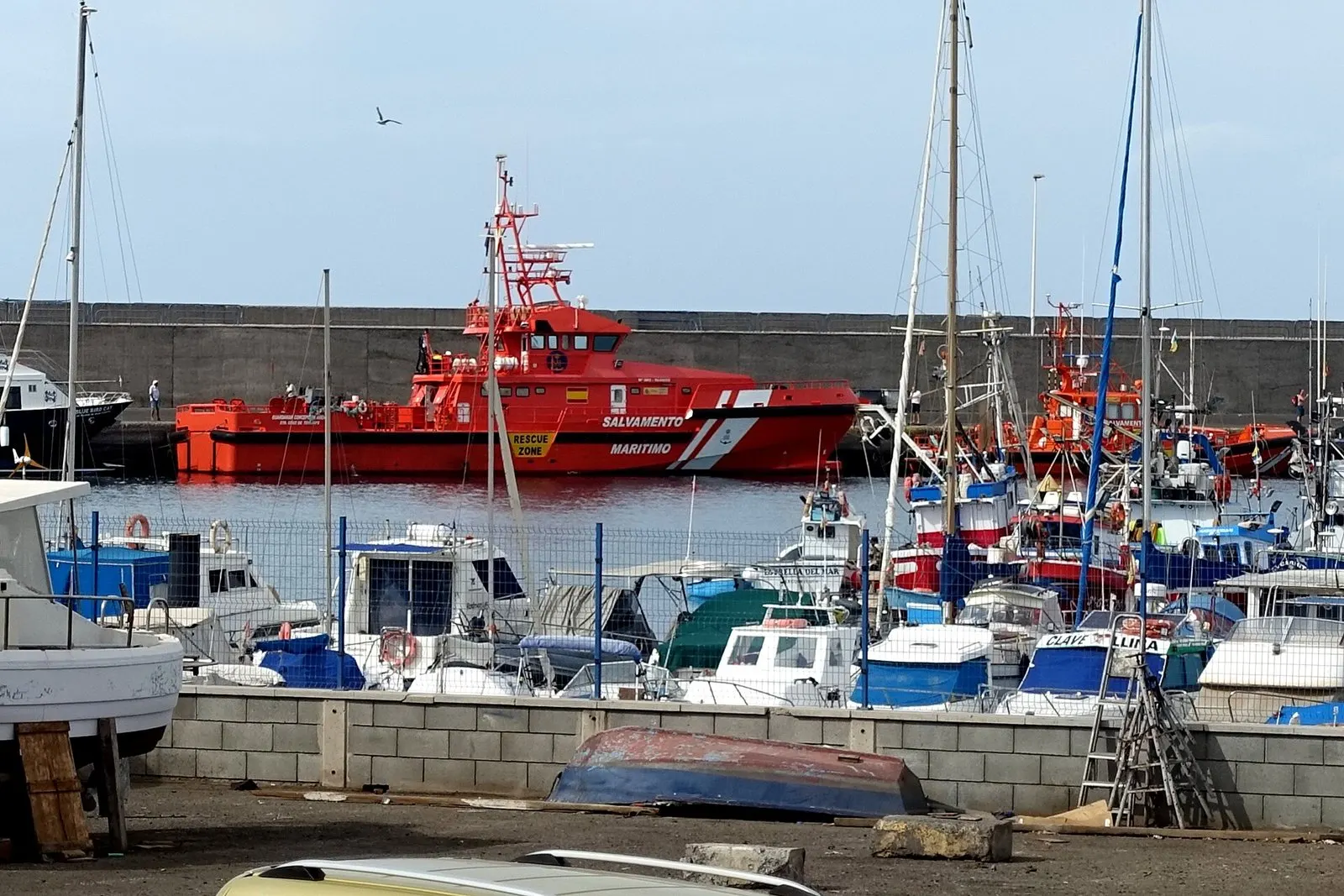
Fishing boats and the Maritime Rescue vessel in Arguineguín harbour.
Arguineguín at a glance
Where
Eastern end of Mogán, on the south-west coast of Gran Canaria
From the airport
About 42 km, just over half an hour on the GC-1
Market
Tuesdays, 8:30 to 15:00 (town council)
Beaches
El Perchel, Las Marañuelas, Costa Alegre and, to the west, Patalavaca
Scheduled boats
Líneas Salmón and Blue Bird to Anfi, Puerto Rico and Puerto de Mogán
Best for
Anyone after a real town with fish restaurants and calm beaches
What is Arguineguín? Mogán’s fishing town
Arguineguín is a coastal town of more than two thousand residents at the eastern edge of Mogán, right where the Arguineguín ravine meets the sea and the municipality borders San Bartolomé de Tirajana. Unlike Puerto Rico or Amadores, which were built for tourism, there was a village here first: fishermen’s houses, a quay and a living made from the sea.
The origin of the name is uncertain. It already appears in Le Canarien, the chronicle of the Norman conquest in the early fifteenth century, and scholars consider it probably pre-Hispanic. The romantic translations you will find online have no academic backing.
The twentieth century gave it two defining features. The first was the cement works built in the 1950s across the ravine at El Pajar (already in San Bartolomé de Tirajana) to use the local pozzolana; the company that runs it, Ceisa, dates its start to 1957. The second came from northern Europe: the Norwegians, who made Arguineguín their winter home.
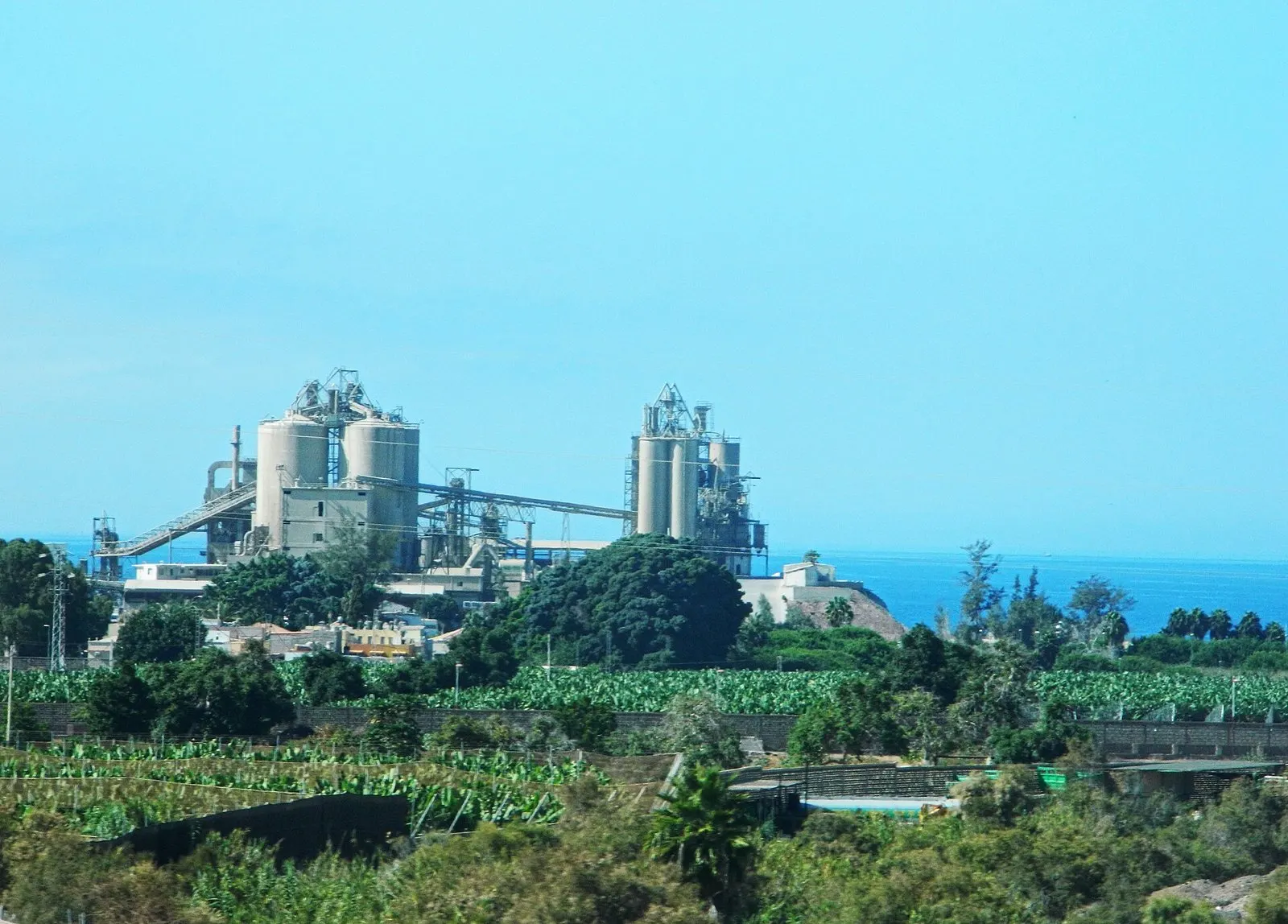
The silos of the El Pajar cement works, across the Arguineguín ravine.
The Norwegian colony: why Arguineguín sounds Norwegian
In season, walk through the centre on a Tuesday and you may well hear more Norwegian than English. According to the consulate, quoted by the EFE news agency in 2023, between 7,000 and 8,000 Norwegians spend October to March in the municipality. There has been a Norwegian school since 1974, a social club with hundreds of members, and the Norwegian Seamen’s Church (Sjømannskirken), which has been in its current premises by the promenade since 2008. Norwegian businessman Bjørn Lyng founded the Anfi group in 1988; its resort is a short walk away.
For visitors this means very concrete things: signs and menus in Norwegian, bakeries and supermarkets with Scandinavian products, and the feel of a long-stay resident community rather than a quick-turnover resort. It also explains the seasons: the town is livelier from autumn to spring than in August.
What to see in Arguineguín: the essentials
Arguineguín has no single monument that justifies the trip on its own. What it has is a combination best enjoyed slowly, and you can see it all in a day. In order of importance:
The harbour and the fishermen’s guild, the heart of the town.
The El Perchel natural pool, seawater refreshed by the tides.
The beaches: Las Marañuelas, Costa Alegre and, a stroll away, Patalavaca.
The Tuesday market, one of the best known in the south.
The seafront promenade to Patalavaca and Anfi del Mar.
Sunset from the promenade: on very clear days you can see Tenerife and Mount Teide.
And as a day trip: the Soria Dam, up the ravine.
The town, the harbour and the coast to Patalavaca from a drone. Video by the channel Hotels & Resorts All Around the World.
Arguineguín harbour and the fishermen’s guild
The harbour is the town’s reason for being. The official Mogán tourism page describes the Arguineguín fishermen’s guild (Cofradía) as the largest fishing port in Gran Canaria, with around 35 boats and up to 60 fishermen, rising to 200 during the tuna season. The port also has 93 berths, boat trips leave from here and the scheduled passenger boats call in.
By the quay, the Cofradía runs a fishmonger’s and a restaurant. It is the most direct way to eat fish landed in that very harbour, which is why it fills up: in high season, expect to queue at lunchtime.
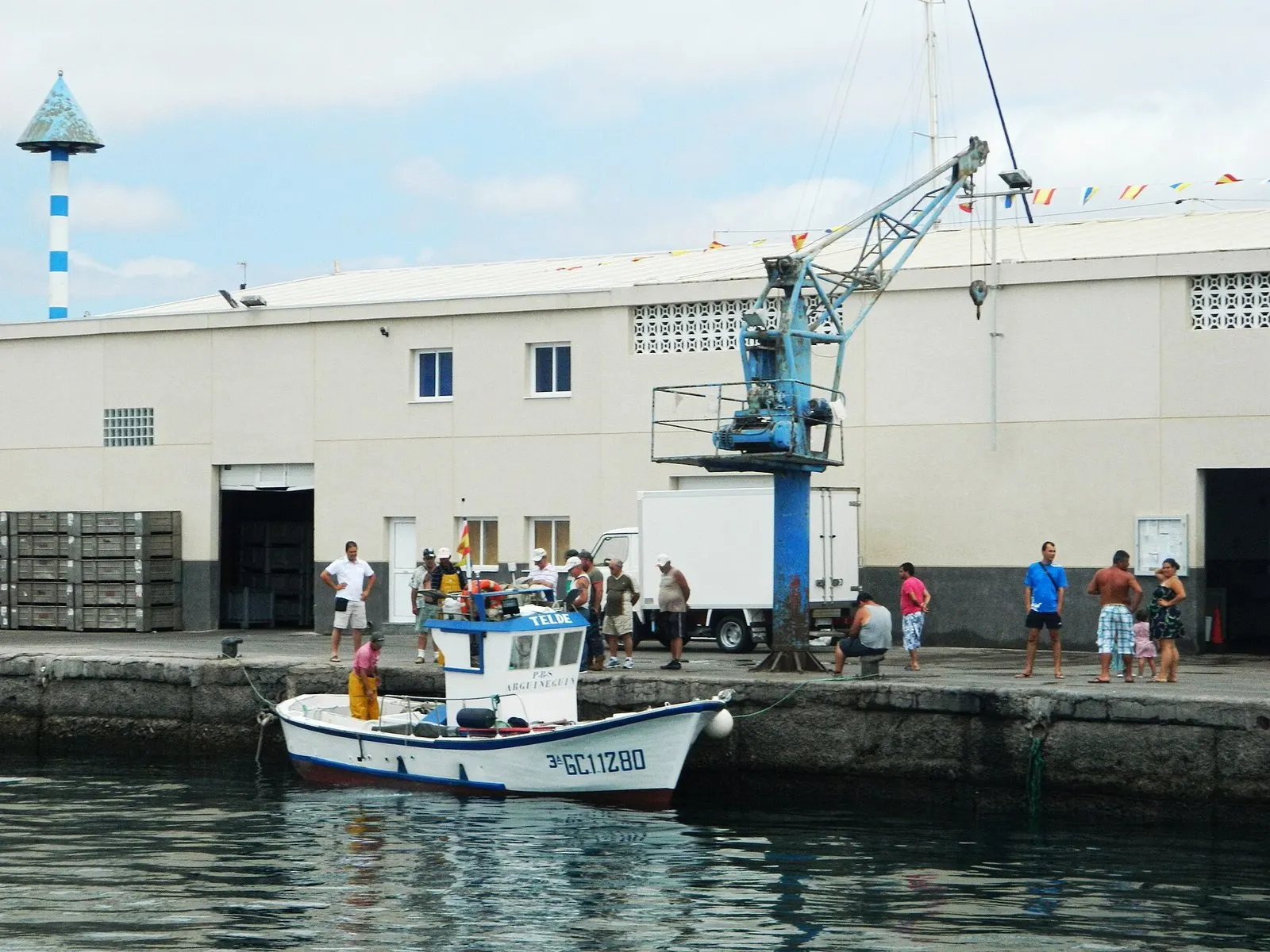
A fishing boat moored in front of the quay warehouses.
The quay is also part of recent history. In 2020 it made headlines across Europe because of the migrant camp that stood on it for months, and on 11 June 2026 Pope Leo XIV visited, leaving flowers in memory of those who died on the Atlantic route.
Beaches in Arguineguín and Patalavaca
A word of warning before you search the map: “Arguineguín beach” is not the official name of any beach. Every website uses it for a different one (Las Marañuelas, El Perchel or little La Lajilla). These are the official names and figures from Mogán tourism, from east to west:
Beach
Length
Sand
Highlights
El Perchel
220 m
Golden and black
The tidal pool, a playground and an accessible shower
Las Marañuelas
279 m
Black
The town beach: calm water, lifeguard, sunbeds and step-free access
Costa Alegre (La Lajilla)
55 m
Golden sand and gravel
A cove sheltered by a breakwater: very calm swimming
Patalavaca
303 m
Black, pebbles and sand
Promenade, hotels and a residential feel
Aquamarina
70 m
Golden
Small and tucked away at the end of Patalavaca
Anfi del Mar
180 m
Golden, pebbles and sand
Calm water and full facilities
No beach in Mogán is on the 2026 Blue Flag list. That says nothing bad about the water: it is an award councils apply for, and here it was either not requested or not granted this year. In the municipality, the Puerto de Mogán marina does fly it.
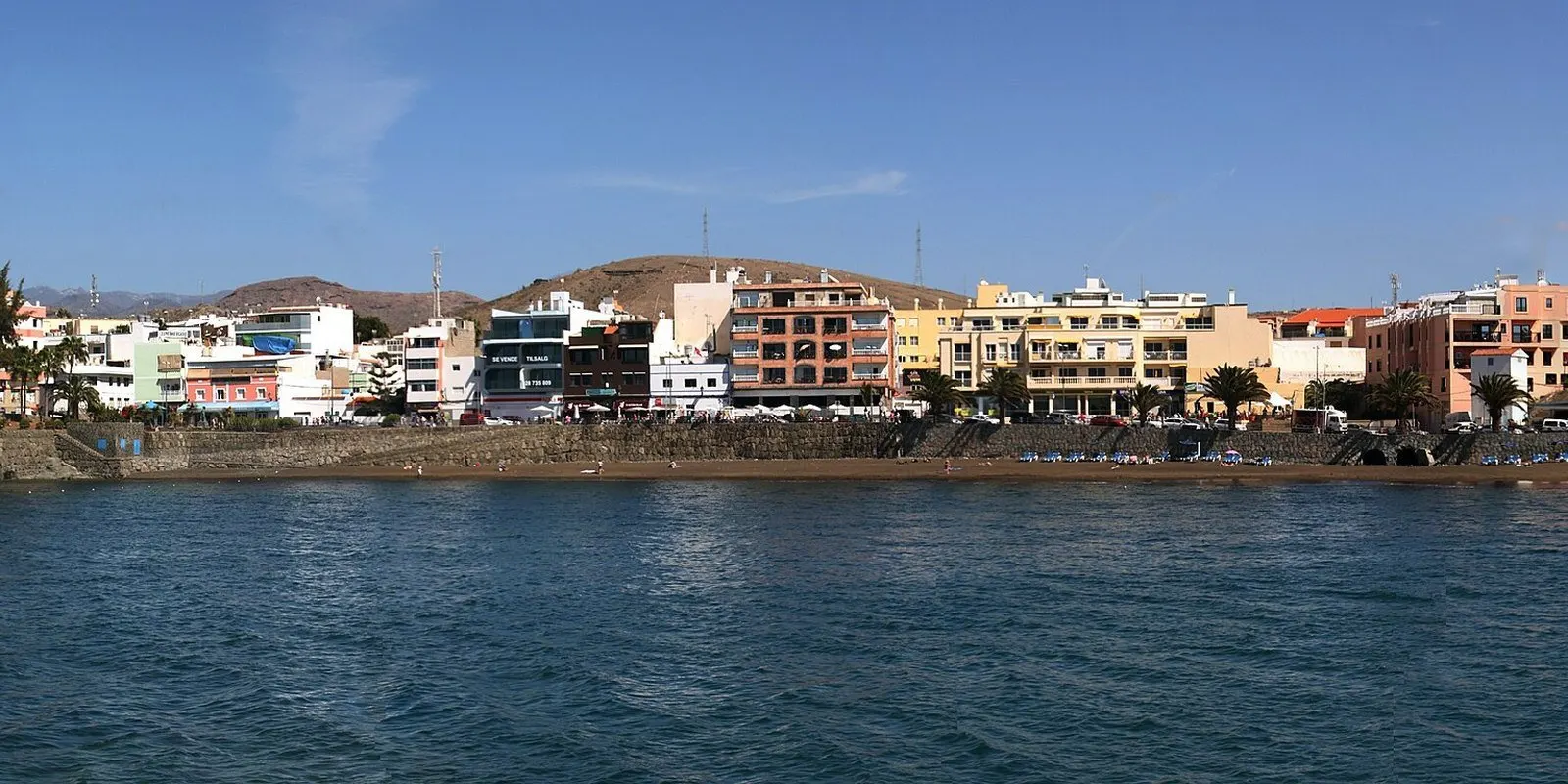
Arguineguín from the sea, with the Las Marañuelas waterfront.
Las Marañuelas beach
Arguineguín’s town beach, right in the centre next to the square of the same name. Dark sand, calm water and every facility: toilets, foot showers, lifeguard, sunbed hire and access for people with reduced mobility. It has a webcam (run by SkylineWebcams, the network Mogán tourism links to), although it has not sent a new image since April 2025; the El Perchel and La Lajilla cameras do work. It is the beach of locals and families, with no airs and graces.
Costa Alegre or La Lajilla
A cove just 55 metres long that its breakwater turns into a kind of pool: this is the one many websites call “Arguineguín’s natural pool”, although the natural pool proper is the one at El Perchel (see below). Golden sand and gravel, lifeguard and sunbeds. It fills up quickly, so it works best early in the day.
The Costa Alegre cove, in a post by @arguineguinholidays.
Patalavaca beach
Patalavaca is the strip of hotels and apartments joining Arguineguín to Anfi del Mar, and its 303-metre beach is black sand with pebbles. The council lists calm water, toilets, lifeguard, sunbeds and adapted access. Water shoes make it more pleasant: the pebbles at the shoreline are hard on bare feet.
The Patalavaca seafront, seen from the boat coming from Puerto Rico.
Arguineguín natural pool: El Perchel
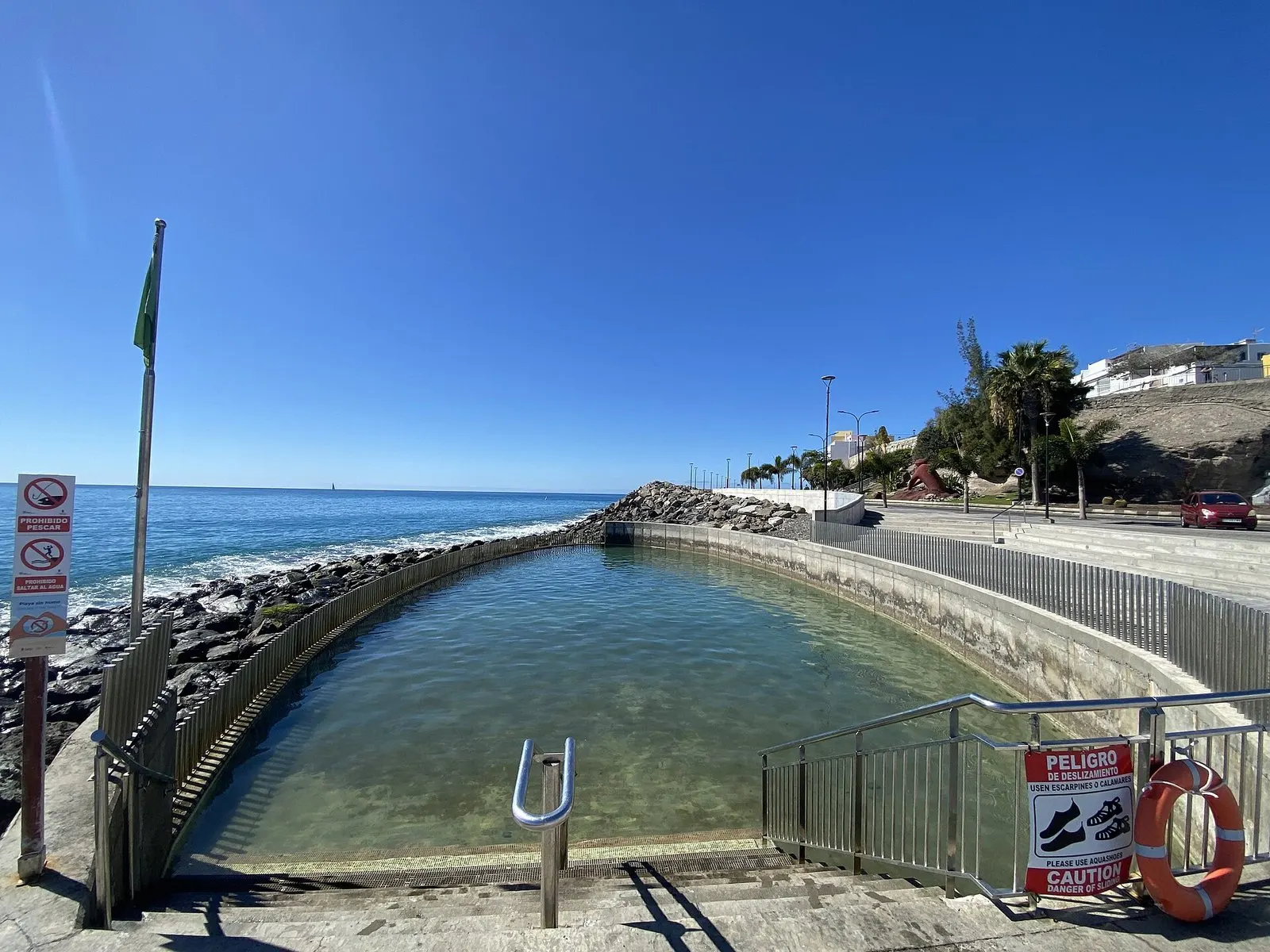
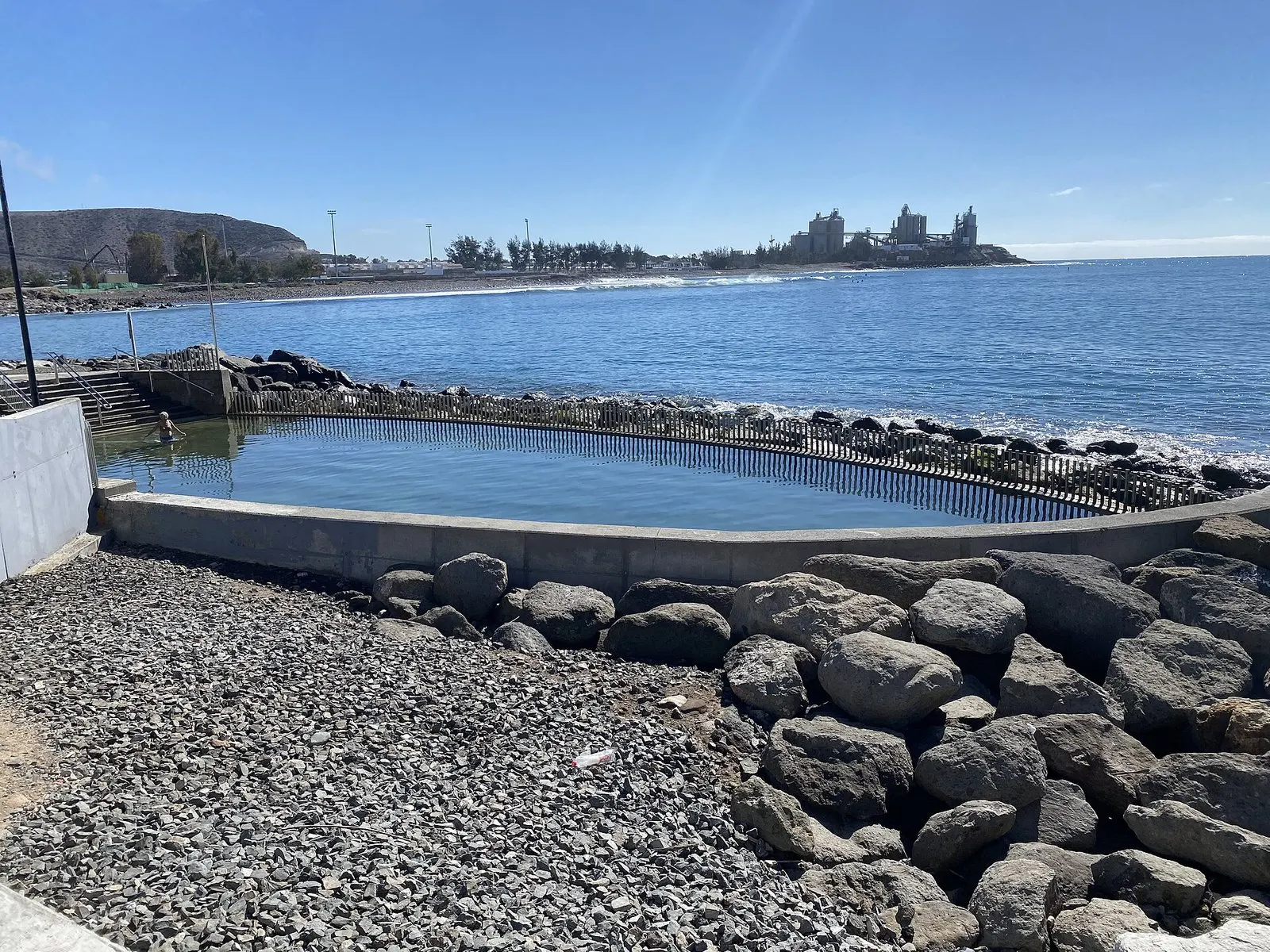
Arguineguín’s natural pool is at El Perchel beach, by the mouth of the ravine. It is a tidal pool: the sea fills and empties it with the tides, so the water refreshes itself. The council rebuilt the whole beach and reopened it on 16 September 2022, with a 440-metre promenade, the rebuilt pool and an accessible sea-entry point for people with disabilities.
The El Perchel pool, with its steps and the promenade railings.The pool, protected from the swell by the breakwater.
Go at high or mid tide, when the pool is full and the water clearest; at very low tide it gets shallow. The signs at the entrance set out the rules: follow them, especially when there is a swell. If you enjoy this kind of swim, we have a guide to the natural pools of Gran Canaria.
When there is a swell, stay off the pool and the rocks. Waves can break over the breakwater even when the sea looks calm from the promenade. Check sea conditions and respect the flags and signs.
Arguineguín market: Tuesdays
The Arguineguín municipal market runs every Tuesday from 8:30 to 15:00 in Plaza Negra, according to Mogán’s tourism website. Expect fruit and vegetables, clothes, shoes, bags, costume jewellery and souvenirs. On the same day and with the same hours there is a craft market in Plaza de Las Marañuelas, plus a second-hand flea market in Plaza Negra that closes a little earlier, at 14:30.
Some websites give 8:00 to 14:00; we go with the official hours. A practical tip: arrive before eleven, when the stalls are up and there is still room to walk. Then add the harbour and a fish lunch: it is the classic southern Tuesday.
A Tuesday market walked on foot. Video by the channel Gran Canaria Walks.
The seafront walk from Arguineguín to Patalavaca and Anfi
One of the best free things to do here is walking by the sea from Las Marañuelas to Anfi del Mar beach: about 3 kilometres, around 40 minutes at an easy pace, past Costa Alegre, Patalavaca and Aquamarina. It is flat almost all the way.
The path is not equally well kept from end to end: some stretches have been renovated and others are more worn. With a pushchair or wheelchair, it is best done in parts.
The whole walk by the sea, from Arguineguín to Anfi del Mar. Video by the channel Gran Canaria Walks.
At the end waits Anfi beach, with its light sand and calm water. If you are spending the day there, read our Anfi del Mar guide first.
Where to eat in Arguineguín: fish from the harbour
For us, Arguineguín is the best place in the municipality to eat fish without paying a premium for the view. The usual rule works: ask what came in today and let them recommend it. Besides the Cofradía, these are listings from our directory with plenty of reviews and good ratings:
If you would rather buy and cook, the fishmonger’s on the quay opens in the mornings; check its hours on the listing before you go.
La Aquarela: a Michelin star in Patalavaca
Patalavaca is home to one of the two starred restaurants in the municipality: La Aquarela, with one star in the 2026 Michelin Guide and two Repsol Suns. Since May 2026 the kitchen has been led by Desiré Cabrera, who had already spent more than a decade at the restaurant (Canarias7, 2 May 2026). If it is your plan for a special night, see our guide to Michelin-starred restaurants in Gran Canaria.
Coordinates from OpenStreetMap. Each button opens directions in Google Maps.
Day trip to the Soria Dam up the Arguineguín ravine
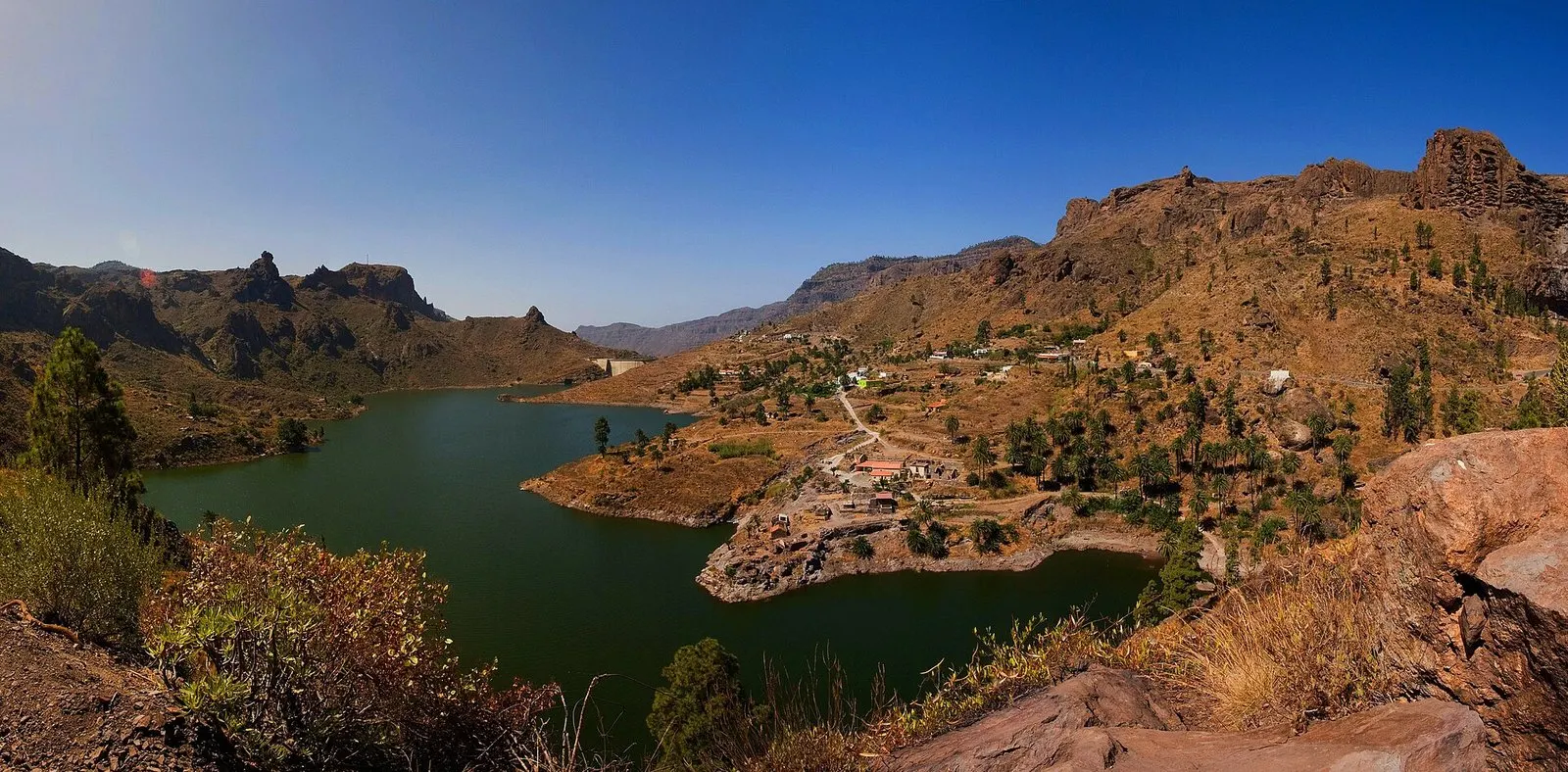
From the town, the GC-505 climbs the Arguineguín ravine inland and, after about 25 kilometres and 40 minutes, reaches the Soria Dam (Presa de Soria). It could hardly be more different from the coast: rock walls, palm trees, hamlets and, at the end, the reservoir.
It is the largest dam in the Canary Islands by height and by capacity: a concrete arch 120 metres above the riverbed (132 including its foundations), built between 1962 and 1972 to hold 32 cubic hectometres. It has never been full: its peak was about 12.5 hm³ in January 2011.
The Soria reservoir, at the head of the Arguineguín ravine.
The road is narrow, steep and very winding on the last stretch: take your time and make sure the car is in good shape. At the top, in the hamlet of Soria by the reservoir, is Restaurante Casa Fernando, well known among hikers. On foot, Mogán tourism describes the R8 Barranquillo Andrés – Soria route: 10 km, about 4 hours, moderate to hard, with some poorly signposted sections.
The bus does not reach the dam: Global’s line 6, a shared taxi-bus, only goes from Arguineguín up to Cercado de Espino and Barranquillo Andrés. For this trip, you need a car.
How to get to Arguineguín
Distances from Arguineguín
By road, without traffic. Add a good fifteen minutes in high season.
DestinationKmTime
Gran Canaria Airport42 km33 min
Las Palmas de Gran Canaria63 km49 min
Maspalomas lighthouse12 km15 min
Anfi del Mar3 km6 min
Puerto Rico6 km9 min
Puerto de Mogán16 km20 min
Soria Dam25 km40 min
By bus
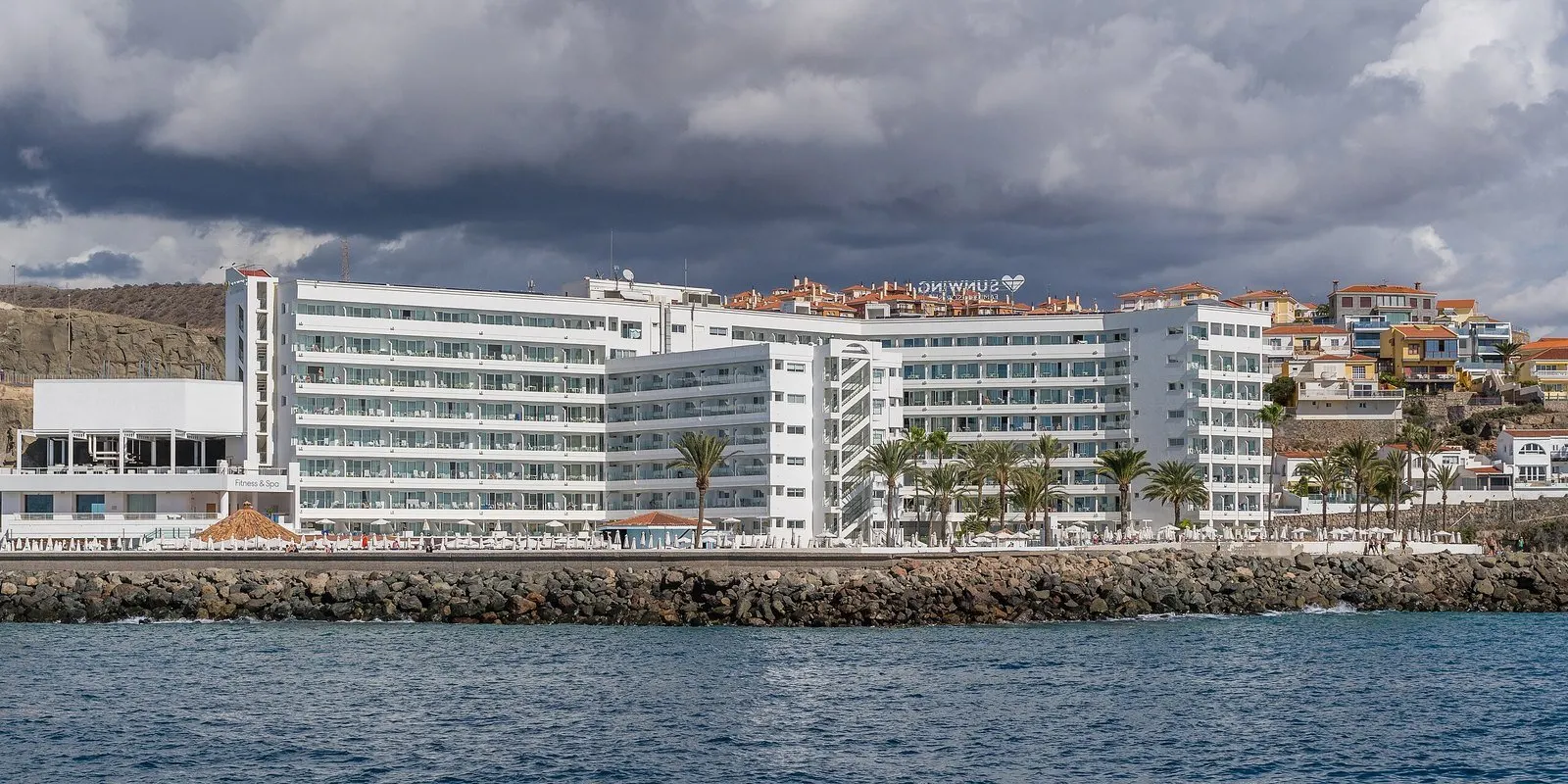
Arguineguín is well served by Global, with several stops (Casa Memo, Arguineguín, Sunwing, Patalavaca and Aguamarina). From the airport you can take the 91 (Las Palmas – Puerto de Mogán, direct), the 1 (Las Palmas – Puerto de Mogán via the airport) and some services of the 90. Along the coast, lines 9, 33, 39 and 70 also stop here. The 32 does not stop in Arguineguín. Timetables change with the season: check guaguasglobal.com or the Global app.
By car and parking
Take the GC-1 and leave at exit 56 (Arguineguín). Parking in the centre is the trickiest part of the visit, especially on market Tuesdays: arrive before mid-morning or leave the car towards Patalavaca and walk along the promenade. If you need wheels, see car hire in Arguineguín.
By boat: Líneas Salmón and Blue Bird
Arguineguín is one of the four stops of the scheduled boats run by Líneas Salmón and Líneas Blue Bird, along with Anfi del Mar, Puerto Rico and Puerto de Mogán. Both leave from the quay. According to their websites in November 2026, Salmón leaves Arguineguín every hour from 10:15 to 16:15, plus one at 17:00 to Anfi and Puerto Rico, and Blue Bird every hour from 10:45 to 15:45 to Puerto de Mogán (to Anfi and Puerto Rico it adds 16:45 and 17:30, plus extra sailings on market Tuesdays). Blue Bird puts the trip to Puerto de Mogán at about 75 minutes, as it calls at Anfi and Puerto Rico on the way.
Salmón’s adult fares are 5 € to Anfi, 8 € to Puerto Rico and 15 € to Puerto de Mogán (one way), with a discount for children aged 6 to 12 and free travel for under-6s. Check the day’s timetable at lineassalmon.es or lineasbluebird.com: it depends on the sea.
The four stops of the scheduled boat, on the official @lineassalmon account.
Taking the boat to Puerto de Mogán is one of the best ways to see the south-west cliffs, which are hidden from the road. If Puerto de Mogán is your final destination, we have a guide on how to get to Puerto de Mogán with every option.
Kayaking and boat trips from Arguineguín
The calm water on this coast is ideal for paddling. A guided double kayak tour of about 5 hours leaves from Arguineguín, stopping at coves and sea caves; you need to be able to swim and the minimum age is 8.
Arguineguín has one of the most stable climates on the island: according to the 1991-2020 normals, the average high runs from about 20 °C in January to nearly 28 °C in August, and it hardly rains. This is the live forecast for the coming days:
23°
Arguineguín · Now
Mostly sunny
Humidity 69%Wind 7 km/h
Next 7 days · tap a day for hourly detail
Today2 Nov28°22°3%
HourTempRainWindUV
09:0025°3%6km/h0
12:0028°3%15km/h5
15:0028°0%8km/h5
18:0025°3%4km/h0
21:0023°0%6km/h0
Tomorrow3 Nov26°21°10%
HourTempRainWindUV
09:0024°0%3km/h1
12:0026°3%8km/h5
15:0025°10%9km/h5
18:0024°5%9km/h0
21:0022°0%4km/h0
Wed4 Nov25°20°3%
HourTempRainWindUV
09:0022°0%5km/h1
12:0025°3%11km/h5
15:0025°0%10km/h5
18:0023°0%8km/h0
21:0022°0%6km/h0
Thu5 Nov25°20°3%
HourTempRainWindUV
09:0022°3%3km/h1
12:0024°0%8km/h5
15:0025°0%17km/h5
18:0024°0%11km/h0
21:0023°0%7km/h0
Fri6 Nov26°21°0%
HourTempRainWindUV
09:0024°0%5km/h1
12:0025°0%10km/h5
15:0025°0%13km/h4
18:0024°0%10km/h0
21:0023°0%7km/h0
Sat7 Nov26°22°5%
HourTempRainWindUV
09:0024°3%9km/h1
12:0026°3%16km/h5
15:0026°3%15km/h5
18:0024°4%11km/h0
21:0022°4%4km/h0
Sun8 Nov27°22°43%
HourTempRainWindUV
09:0023°9%5km/h1
12:0027°13%13km/h4
15:0025°20%14km/h3
18:0024°29%11km/h0
21:0023°38%12km/h0
Live forecast from Open-Meteo for Arguineguín, updated hourly. Weather models work on a grid of roughly 10 km, so the coastal towns of the municipality share the same cell: the figures for Puerto de Mogán, Puerto Rico and Arguineguín are effectively the same forecast, adjusted for altitude. Inland Mogán village is a separate cell and does differ.
To plan month by month, sea temperature included, see our Arguineguín weather guide. And if you want to see the beach right now, several of them have live webcams (in town, El Perchel and La Lajilla are working): we gather them in Mogán live webcams.
Fiestas del Carmen: the July sea procession
If you are here in July, do not miss it. Arguineguín’s Fiestas del Carmen take place in the middle of the month, with a romería and offering, Mass and a procession on the Virgin’s day, and the highlight: the sea procession, with the Virgin carried on board and the fishing fleet dressed up behind.
In 2026 the festival ran from 6 to 19 July: on Sunday the 19th the statue was carried down to the quay at 9:00 and, after Mass, sailed to Playa de Mogán to meet the Virgin there. Dates change every year: check the council’s programme.
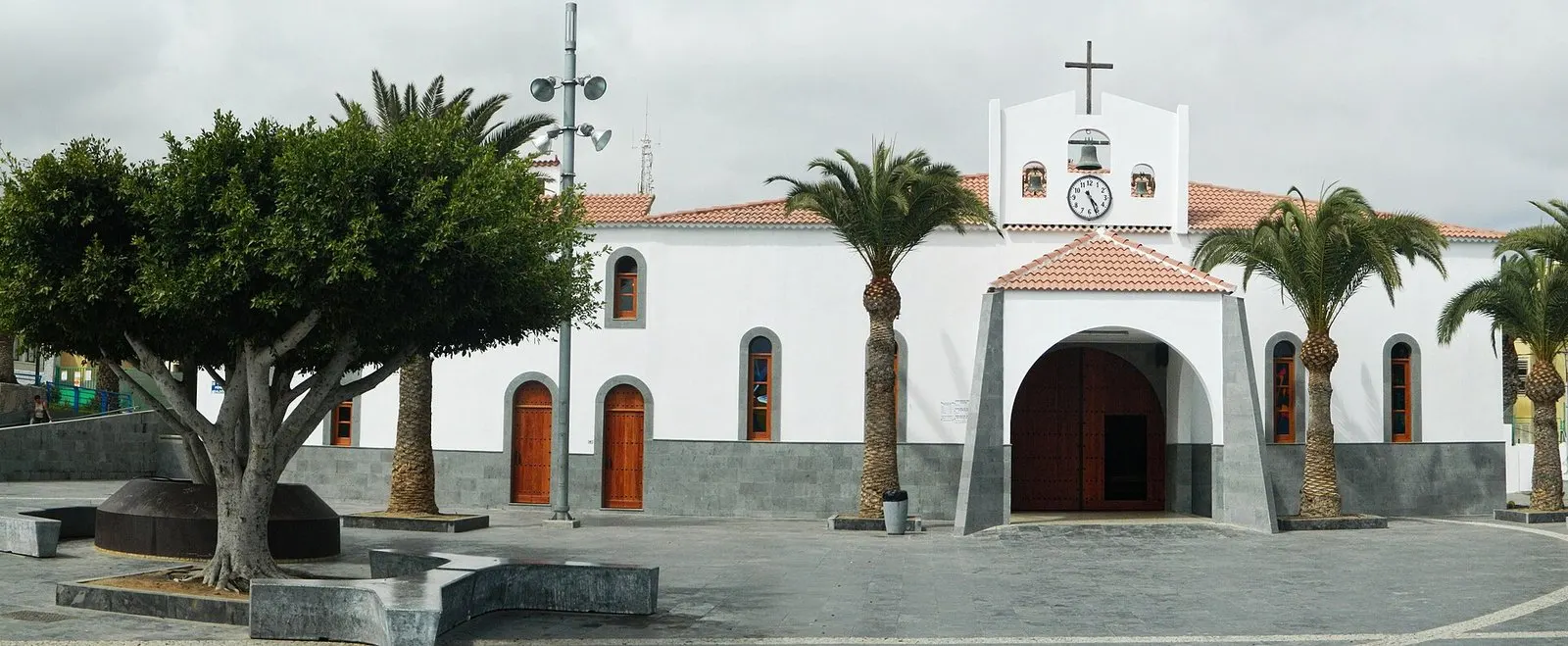
The church, in the town centre.
Where to stay in Arguineguín and Patalavaca
Arguineguín works very well as a base: half an hour from the airport, with buses and boats along the whole coast, and a life of its own outside high season. These hotels have lots of reviews and high ratings in our directory:
MarketPlaza Negra and Plaza de Las Marañuelas, before it gets busy.
11:30
Quay and guildThe boats, the fishmonger and the feel of the harbour.
13:30
Fish lunchAt the Cofradía or one of the town restaurants.
15:30
SwimEl Perchel pool at high tide, or Las Marañuelas.
17:00
Walk to AnfiAbout 40 minutes by the sea, via Patalavaca.
18:15
SunsetWinter time; in summer the sun sets at around 21:00. From the promenade, with Tenerife on the horizon if it is clear.
Is Arguineguín for you?
You will like it if…
You want a town with local life, not just hotels
You want fresh fish at fair prices
You prefer quiet beaches and calm water
You travel without a car: buses to the airport and boats along the coast
You come in winter and fancy a long stay
Maybe not for you if…
You are after a big golden-sand beach
You want lively nightlife
A large foreign resident community bothers you
You drive in on a Tuesday at midday: parking is hard
Arguineguín FAQs
Before you go
What is there to see and do in Arguineguín?
The essentials are the harbour with the fishermen’s guild, the El Perchel natural pool, the beaches of Las Marañuelas, Costa Alegre and Patalavaca, the Tuesday market and the seafront walk to Anfi del Mar. For something active, kayak or take a boat along the coast and, as a day trip, drive to the Soria Dam, about 40 minutes up the ravine.
What day is Arguineguín market?
Tuesday. The municipal market runs from 8:30 to 15:00 in Plaza Negra, with a craft market in Plaza de Las Marañuelas and a second-hand flea market that closes at 14:30.
How do I get to Arguineguín?
From the airport it is about 42 km by car on the GC-1 (exit 56), just over half an hour. By bus, Global lines 91 and 1 (and some line 90 services) stop at the airport and in Arguineguín. From Anfi, Puerto Rico or Puerto de Mogán you can also arrive on the Líneas Salmón and Blue Bird boats. Check timetables at guaguasglobal.com.
Where is Arguineguín and which municipality is it in?
Arguineguín belongs to Mogán and sits at its eastern end, on the south-west coast of Gran Canaria, where the Arguineguín ravine meets the sea. The ravine is the boundary: El Pajar, on the other side, is already in San Bartolomé de Tirajana.
Does Arguineguín have a natural pool?
Yes: the tidal pool at El Perchel beach, by the mouth of the ravine and a few minutes on foot from the quay. It is filled with seawater that changes with the tides and was rebuilt in 2022 with an accessible sea entry. The Costa Alegre cove is also so sheltered by its breakwater that it works almost like a pool.
Which is the best beach in Arguineguín?
None is officially called “Arguineguín beach”. For us, Las Marañuelas is the most complete (facilities and calm water), Costa Alegre the most sheltered, and Patalavaca the best if you are staying in that area. For light sand, follow the promenade to Anfi del Mar.
Where to eat in Arguineguín?
The benchmark is the fishermen’s guild restaurant on the quay, serving fish landed in the harbour itself. In town there are also La Barca, Los Pescaitos and El Marino, all with plenty of reviews. For a special occasion, La Aquarela in Patalavaca has a Michelin star.
What is Patalavaca beach like?
It is 303 metres of dark sand and pebbles with calm water, toilets, a lifeguard, sunbeds and accessible entry, according to the council’s listing. It lies between Arguineguín and Anfi del Mar, less than half an hour on foot along the promenade from Las Marañuelas. Water shoes make getting in easier.
Can I take a boat from Arguineguín to Puerto de Mogán?
Yes. From Arguineguín quay, Líneas Salmón sails every hour from 10:15 to 16:15 and Líneas Blue Bird every hour from 10:45 to 15:45 (timetables published in November 2026). Both also call at Anfi del Mar and Puerto Rico; Blue Bird puts the trip to Puerto de Mogán at about 75 minutes.
Is Arguineguín worth visiting?
Yes, if you like a town with a life of its own: a fishing harbour, fish of the day, a market and calm beaches. One day is enough to see it, ideally a Tuesday. For light sand, carry on along the promenade to Anfi del Mar; for nightlife, Puerto Rico suits you better.
Why are there so many Norwegians in Arguineguín?
It is a long-established community: there has been a Norwegian school since 1974, plus the Norwegian Seamen’s Church and a social club. According to the consulate, between 7,000 and 8,000 Norwegians spend October to March in Mogán.
In short
Arguineguín is the most authentic face of the Mogán coast: a town with a quay, a fishermen’s guild and a market, calm beaches and a promenade linking it to Patalavaca and Anfi del Mar. It is not the postcard spot, and that is exactly why it wins people over. Come on a Tuesday, eat fish by the harbour and stay for the sunset.
The critical eye behind every recommendation. A Canarian local and self-confessed foodie who knows every corner of Mogán. His mission: for every visitor to experience Mogán like a local.
Local Tip
From the heart of Mogán
“The further you move back from the seafront, the better you eat and the less you pay. Two or three streets inland changes both the menu and the bill. That is where locals eat.”
All 95 beaches in Gran Canaria on an interactive map, grouped by municipality and by type, with the best ones picked by who you are travelling with and what you want.