Puerto Rico, Gran Canaria Weather: Live Forecast and Month-by-Month Guide
The 7-day forecast for Puerto Rico, plus average temperatures for every month, sea temperature, and why this bay is reliably sunnier than the rest of the island.
Cristopher OlivaLocal Mogán Explorer
Reviewed
Share
Puerto Rico has a reputation among people who holiday in Gran Canaria for being the spot where the sun comes out even when the rest of the island is grey. That reputation is earned, and there is a geographical reason for it. Here is the live forecast, the monthly averages, and what the numbers do not tell you.
26°
Puerto Rico · Now
Clear
Humidity 48%Wind 4 km/h
Next 7 days · tap a day for hourly detail
Today9 Oct26°21°10%
HourTempRainWindUV
09:0022°0%6km/h0
12:0026°0%8km/h5
15:0026°3%10km/h5
18:0025°10%11km/h2
21:0023°0%6km/h0
Tomorrow10 Oct25°20°10%
HourTempRainWindUV
09:0021°0%6km/h0
12:0024°0%8km/h5
15:0025°0%12km/h5
18:0024°8%10km/h2
21:0023°3%2km/h0
Sun11 Oct25°21°21%
HourTempRainWindUV
09:0022°0%6km/h0
12:0024°0%11km/h5
15:0025°13%13km/h4
18:0025°21%10km/h1
21:0024°9%5km/h0
Mon12 Oct25°21°12%
HourTempRainWindUV
09:0021°0%8km/h0
12:0024°0%10km/h5
15:0025°0%12km/h5
18:0024°0%10km/h2
21:0024°0%4km/h0
Tue13 Oct25°21°0%
HourTempRainWindUV
09:0022°0%3km/h0
12:0025°0%9km/h5
15:0025°0%12km/h7
18:0025°0%10km/h3
21:0024°0%3km/h0
Wed14 Oct30°22°0%
HourTempRainWindUV
09:0025°0%5km/h0
12:0029°0%6km/h5
15:0030°0%10km/h7
18:0028°0%6km/h3
21:0026°0%4km/h0
Thu15 Oct31°25°0%
HourTempRainWindUV
09:0027°0%6km/h0
12:0030°0%5km/h5
15:0031°0%8km/h7
18:0030°0%5km/h2
21:0026°0%5km/h0
Live forecast from Open-Meteo for Puerto Rico, updated hourly. Weather models work on a grid of roughly 10 km, so the coastal towns of the municipality share the same cell: the figures for Puerto de Mogán, Puerto Rico and Arguineguín are effectively the same forecast, adjusted for altitude. Inland Mogán village is a separate cell and does differ.
That forecast updates every hour. If you are reading this a few days before flying, it is the practical answer. The rest of this guide is the part a forecast cannot give you: what those numbers actually feel like, and what changes from month to month.
Puerto Rico weather in short
Hottest month
August, 27,3° average high
Coolest month
January, 20° average high
Warmest sea
August and September, 24,1°
Wettest month
December, about 4,5 rainy days
Driest month
July, almost no rain at all
Annual range
Just 7,3° between hottest and coolest month
Why Puerto Rico is sunnier than the rest of Gran Canaria
Gran Canaria has two climates, and the line between them runs across the middle of the island. The north-east faces the trade winds, which push moist air up against the mountains and hold a low cloud layer over Las Palmas for much of the year. The south-west sits in the rain shadow of those same mountains, and that is where Puerto Rico is.
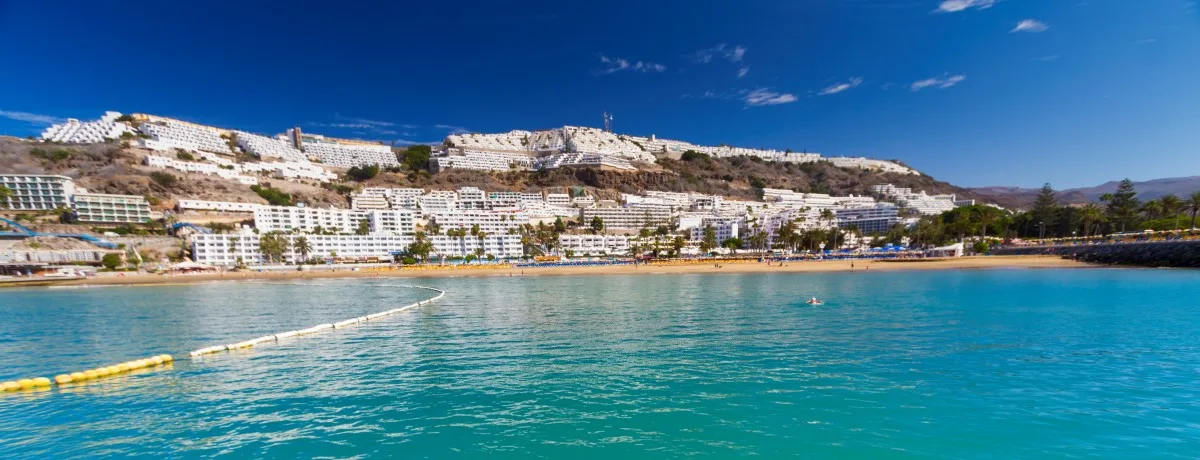
Puerto Rico goes one step further than its neighbours. The resort is built into a steep amphitheatre of cliffs that opens south, which shelters the bay from the north-easterly wind and traps the sun for most of the day. That is the whole secret: it is not a different climate from Mogán or Arguineguín, it is a better-protected version of the same one.
The practical consequence matters more than the meteorology. If you are staying in the north of the island and the sky is grey, driving forty minutes south-west often puts you in full sun. Plenty of residents of Las Palmas do exactly that at weekends.
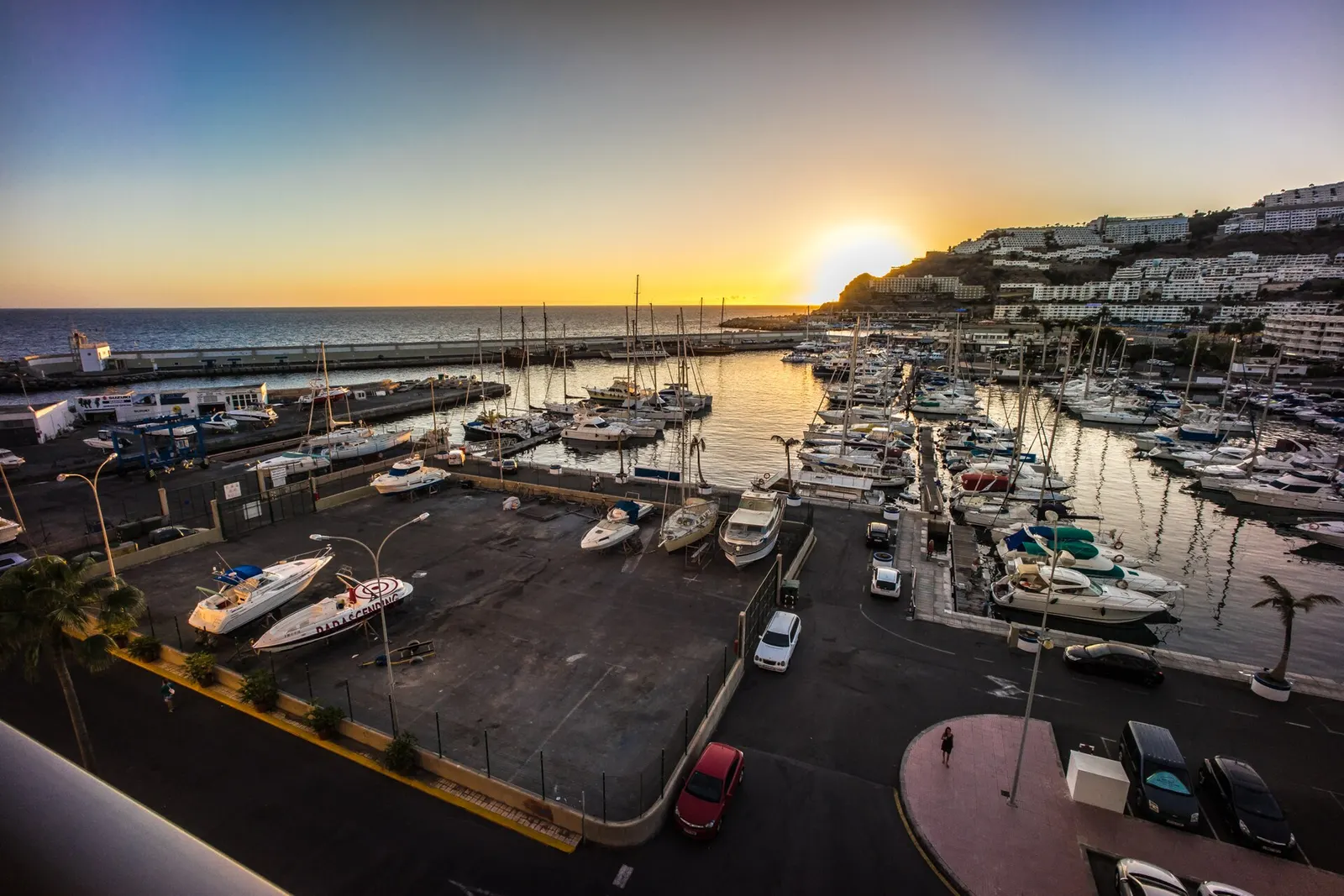
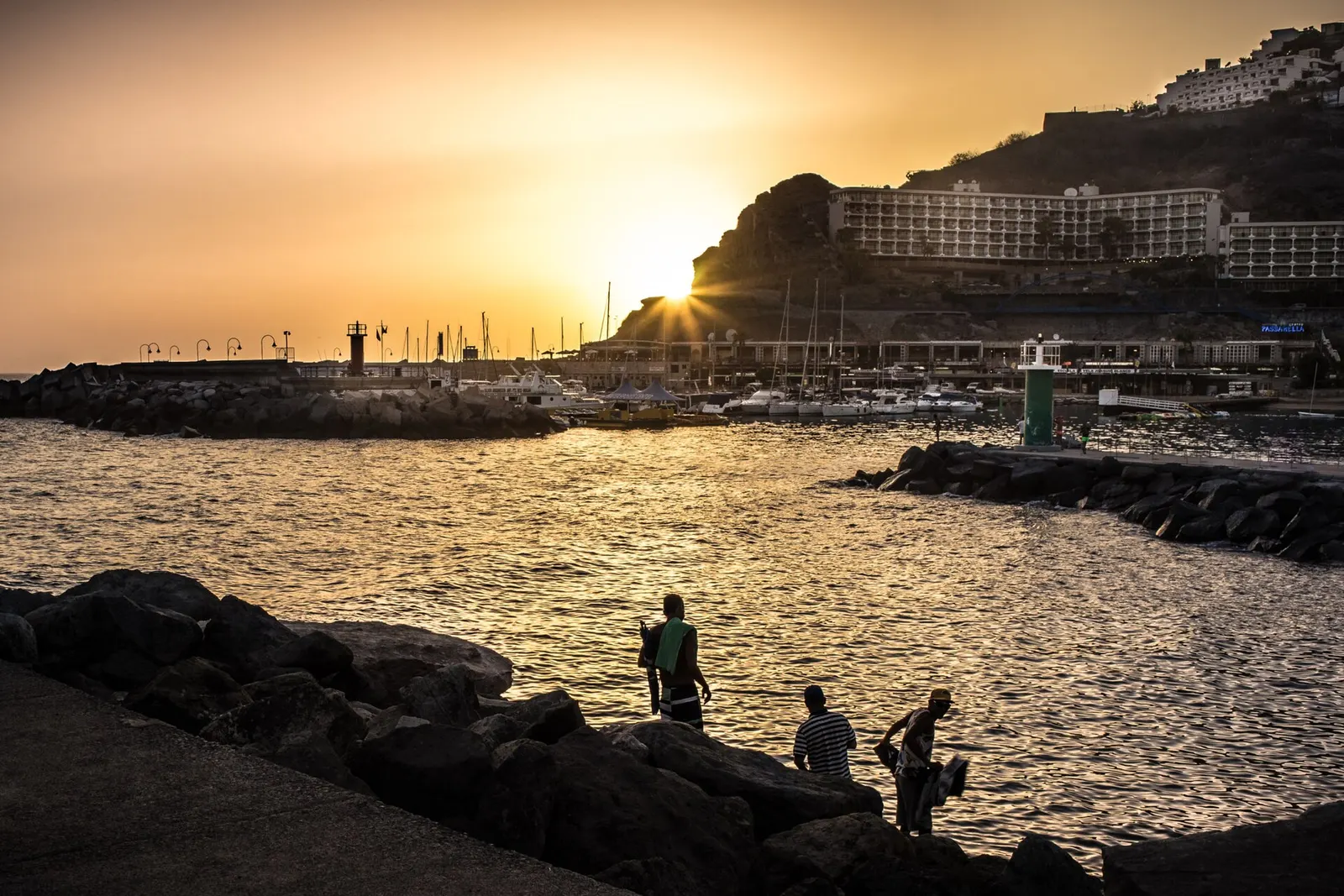
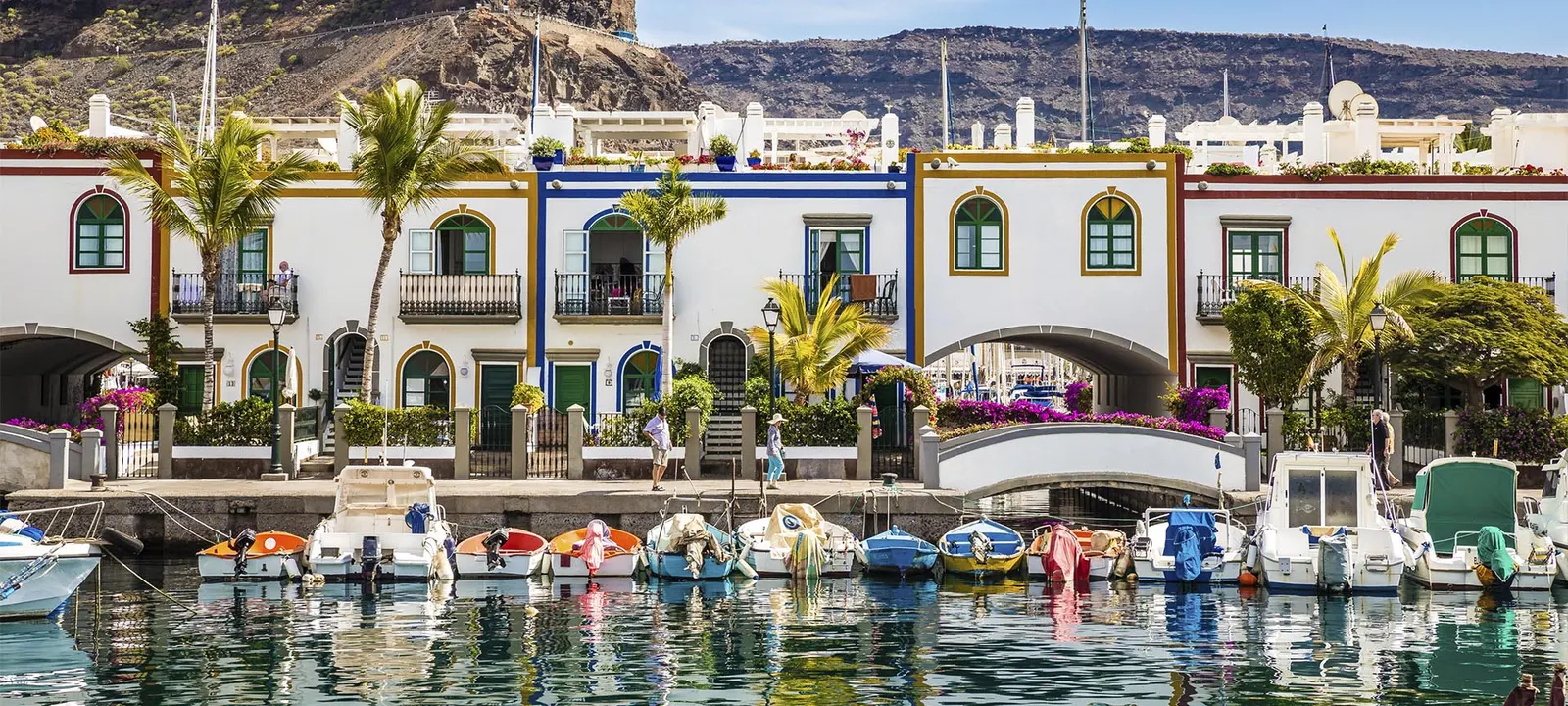
The marina at Puerto Rico at dusk.
The bay from the air and from the promenade. Video by Simon Selmer.
Temperature month by month
These are climate normals for 1991-2020 at Puerto Rico’s own coordinates, not island-wide figures:
Temperature month by month
Average daily high and low. Hover any month for detail.
20°
15.4°Jan
20.2°
15.4°Feb
21.2°
15.8°Mar
21.6°
16.3°Apr
22.8°
17.3°May
24.3°
18.7°Jun
26.4°
20.2°Jul
27.3°
21.2°Aug
26.2°
21°Sep
25.2°
20.3°Oct
23.1°
18.6°Nov
21.1°
16.7°Dec
highlow
Warmest: August 27.7°Coolest: January 20.3°
Climate normals 1991–2020, Open-Meteo (EC-Earth3P-HR model) for 27.82°N, 15.76°W.
The number worth pausing on is the range. Between the coolest month and the hottest there are just over seven degrees. For comparison, most Mediterranean resorts swing by fifteen or more. There is no off-season here in any meaningful sense, which is why the resort fills with northern Europeans in January rather than August.
What the averages hide is how little day-to-day variation there is. A January afternoon in Puerto Rico is very likely to be between 19 and 22 degrees. It is not a place where you check the forecast anxiously; it is a place where you pack for one kind of weather and get it.
Sea temperature
This is the figure that decides whether a winter beach holiday actually works, and it is the one most forecast sites leave out.
Sea temperature month by month
The monthly averages for 2016-2025 range roughly between 20.2° in February and 24.1° in September, so the swimming season here never really closes.
Jan20.8°
Feb20.2°
Mar20.2°
Apr20.7°
May21.5°
Jun22.7°
Jul23.3°
Aug24.1°
Sep24.1°
Oct23.8°
Nov23.1°
Dec21.8°
23° and up: warm21.5-23°: fresh at firstBelow 21.5°: bracing
Daily average 2016-2025 off the Mogán coast, Open-Meteo Marine.
The Atlantic here is cooler than the Mediterranean in summer and considerably warmer in winter, because the Canary Current keeps it stable year-round. In practice: from June to November the water is genuinely pleasant. From December to May it is bracing for the first thirty seconds and fine afterwards, and you will see people swimming every day of the year.
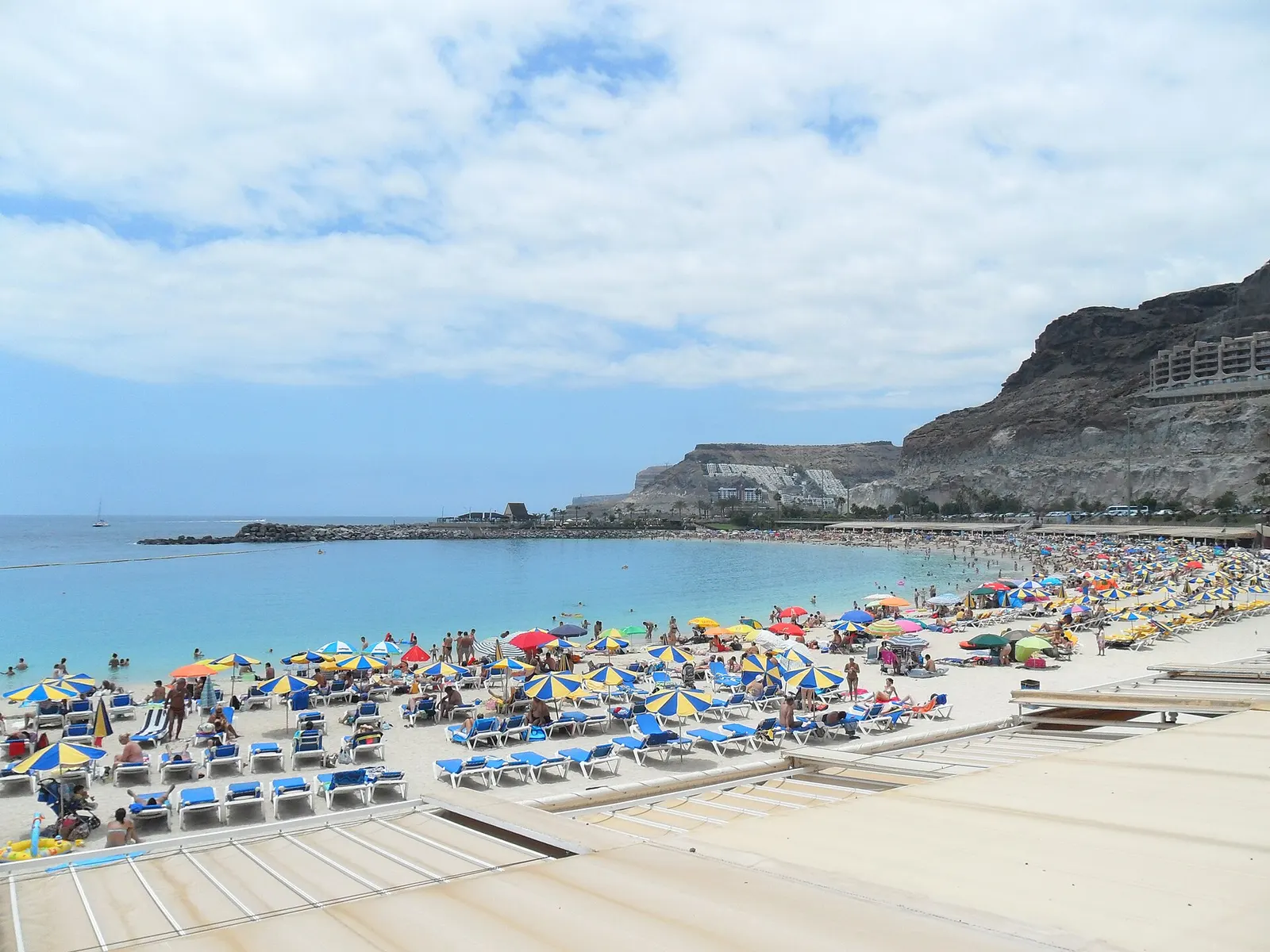
Puerto Rico’s bay is sheltered enough that the water sits still, which makes it feel warmer than the same temperature would in open sea. Amadores, ten minutes away, is even more protected.
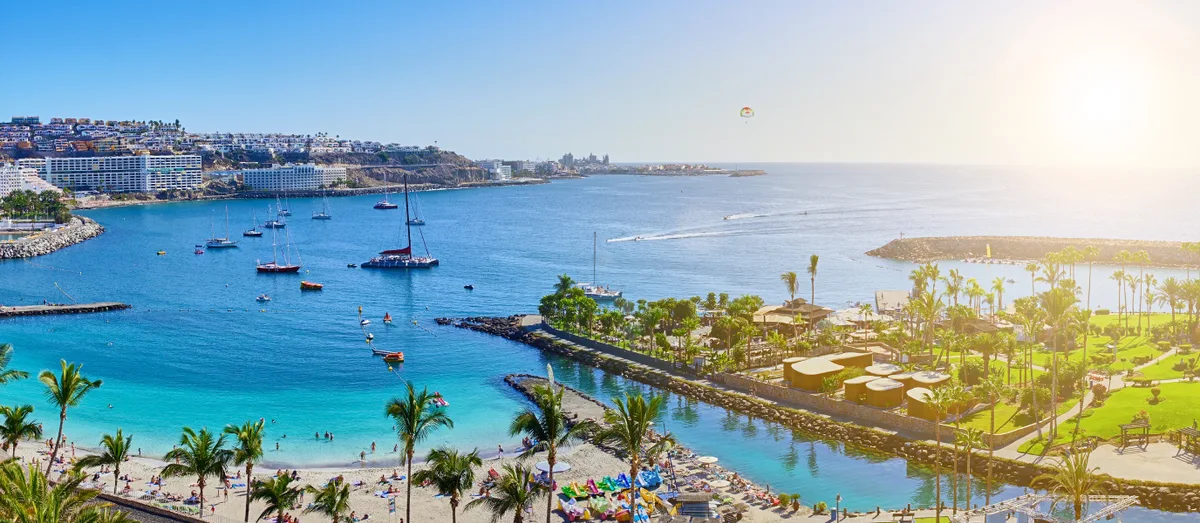
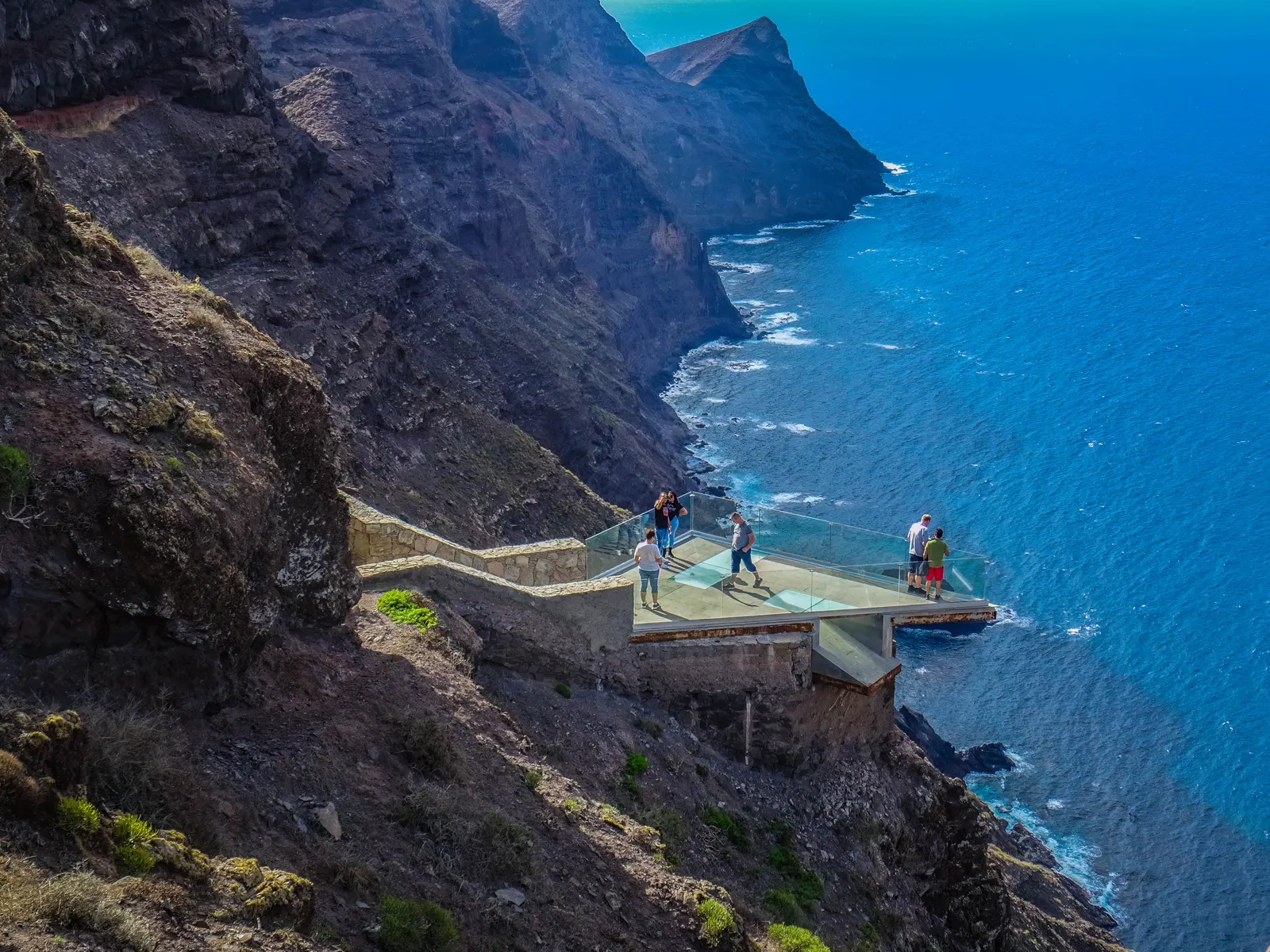
The turquoise bay at Anfi del Mar.The El Balcón viewing platform over the cliffs.Sunset over the harbour, with people fishing.
How much does it actually rain?
Very little, and almost never in summer. July averages a tenth of a rainy day per month across thirty years of records, which is another way of saying it does not rain in July.
The wetter months are November through March, and even then “wet” means three to four days in the month with a millimetre or more. Canarian rain in the south tends to arrive as a short, heavy burst rather than a grey drizzle that settles in for the day. If it rains during your week, it will most likely rain for an hour.
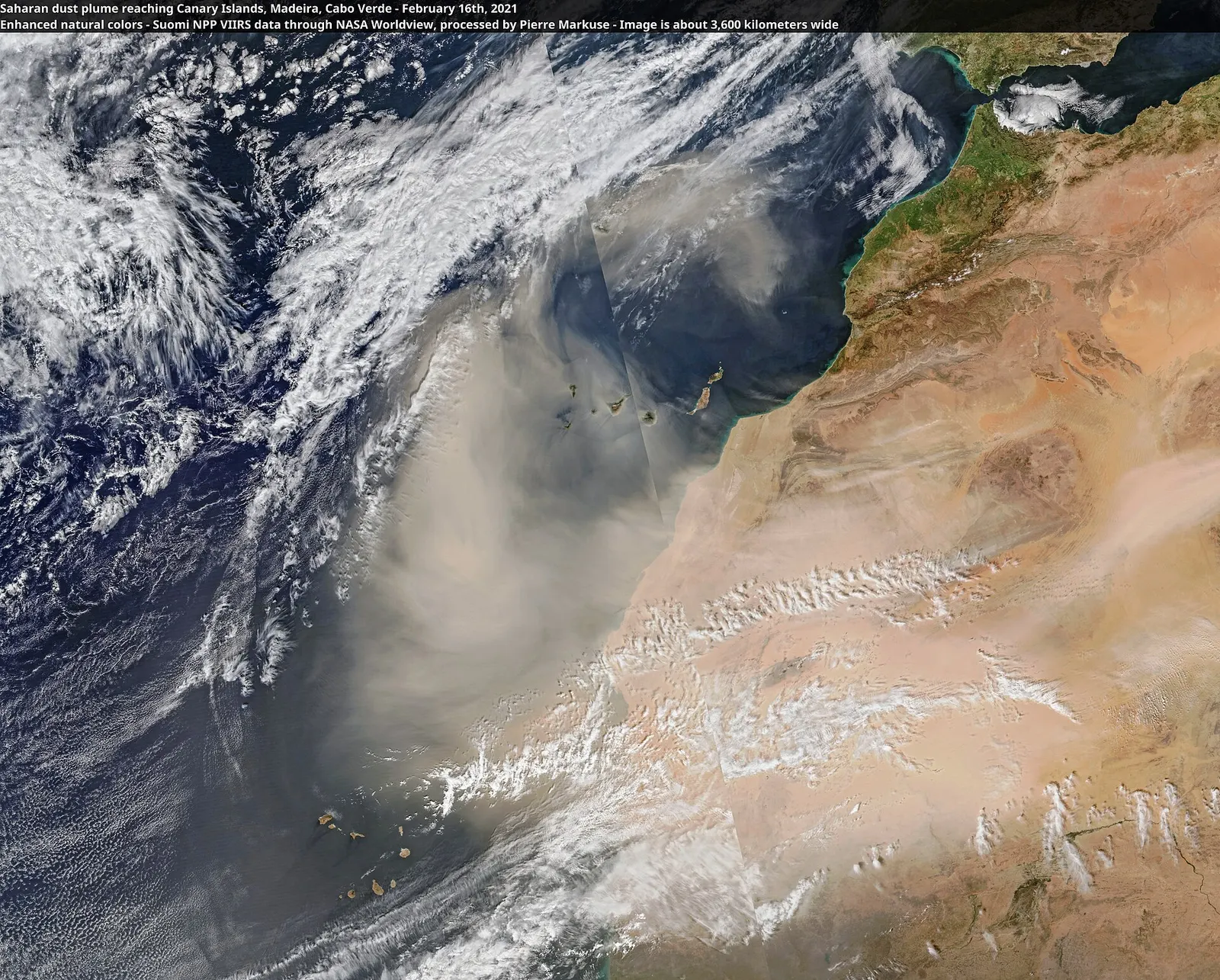
The exception worth knowing about: the calima is a dust haze blown over from the Sahara. It can arrive in any month, drops visibility, turns the sky a flat orange-grey and pushes the temperature up several degrees. It usually clears within two or three days. No forecast app labels it clearly, so if the sky looks wrong and the air feels heavy, that is what it is.
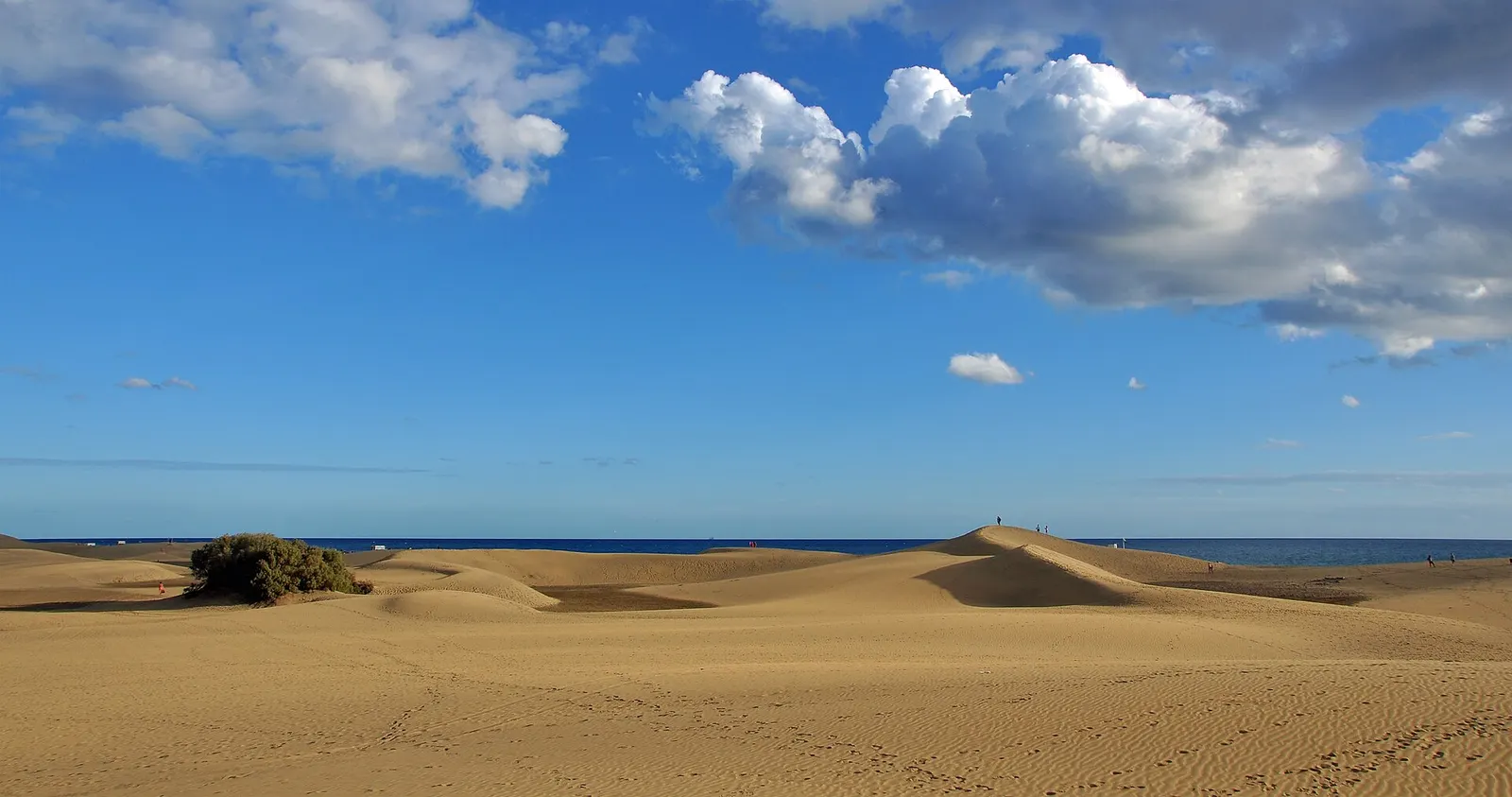
The Maspalomas dunes, fully exposed to the wind.
Wind, and why it matters here
The trade winds blow across Gran Canaria for most of the year, strongest between May and September. The south coast is sheltered from them, but not uniformly, and the difference between resorts a few kilometres apart is real.
Desliza para ver la tabla completa →
Location
Exposure to wind
What it means in practice
Puerto Rico
Very sheltered
The most consistently still of the southern bays
Amadores
Very sheltered
Artificial bay, almost no swell at any time
Puerto de Mogán
Sheltered
Calm inside the harbour, breezier on the promenade
Arguineguín
Moderately exposed
Afternoon breeze picks up more noticeably
Maspalomas
Exposed
Open dunes, wind is a regular feature
The pattern across all of them is the same through the day: mornings are still, the breeze builds through the afternoon, and it drops again at sunset. If wind bothers you on a beach, go in the morning.
When to go, depending on what you want
Because there is no bad month, the question is not when the weather is good but which version of “good” suits you.
Desliza para ver la tabla completa →
Period
Air
Sea
Best for
December to February
20-21° by day
20-21°
Winter sun, quiet beaches, lowest prices in January
March to May
21-23°
20-21,5°
Walking and excursions, the island at its greenest
June to August
24-27°
22,7-24,1°
Beach and swimming, busiest with Spanish visitors in August
September to November
23-26°
23-24°
The warmest sea of the year and thinner crowds
If someone forced us to pick one month, it would be October. The sea is at 23,8°, the air is still in the mid-twenties, the summer crowds have gone and the winter ones have not arrived. The trade-off is that October is one of the four months where rain is at all likely, though “likely” still means about three days.
If you are choosing between the Canaries and somewhere else for a winter break, this is the comparison that matters. These are real December-to-February averages from the last ten years of records, not brochure claims:
Desliza para ver la tabla completa →
Destination
Winter daytime average
Rainy days per month
Flight time from the UK
Puerto Rico, Gran Canaria
21,4°
2,4
About 4h 30
Costa Adeje, Tenerife
21,2°
2,0
About 4h 30
Marrakech
20,6°
4,5
About 3h 30
Funchal, Madeira
18,9°
9,3
About 4h
Málaga
17,2°
5,2
About 3h
Paphos, Cyprus
16,8°
10,9
About 4h 30
Two things stand out. The first is that the Canaries are not marginally warmer than mainland southern Europe in winter, they are four degrees warmer, which is the difference between sitting outside comfortably and not. The second is Madeira and Cyprus: both are marketed as winter-sun destinations, and both average nine to eleven rainy days a month in winter, four times Puerto Rico’s figure.
Tenerife’s south coast is the genuine like-for-like rival, and the numbers are within a couple of tenths of a degree. Choose between them on the resort, not the weather.
The pale sand and promenade at Amadores.
Sun strength, all year round
This is the part visitors from northern Europe consistently underestimate. Gran Canaria sits at 27° north, roughly the same latitude as Florida and southern Egypt, and the sun is correspondingly strong.
In July and August the UV index regularly reaches 10 or 11, which is the “extreme” band. More surprisingly, it stays at 5 to 6 through December and January. a level that will burn pale skin in under an hour. The cool breeze off the Atlantic disguises it, and every winter the resorts fill with people who did not expect to burn in January.
The practical rule locals follow: shade between one and four in the afternoon, whatever the month, and sun cream on any day you are outside for more than half an hour.
The marina at Puerto Rico at dusk.
What a typical day actually looks like
Averages flatten out a pattern that is remarkably consistent from one day to the next. This is the shape of a normal day on this coast, in any season:
The daily rhythm
8am
Still and clearThe calmest part of the day. Flat water, no wind, often the best light.
11am
Warming upThe temperature is close to its daily maximum by late morning.
1pm
Peak sunStrongest UV of the day. Locals move into shade.
4pm
Breeze buildsThe afternoon wind picks up, most noticeably on exposed beaches.
7pm
It drops awayWind falls, temperature eases. The most pleasant hour of the day.
10pm
Cooler than you expectIn winter the night sits around 15°. A jumper earns its place in the case.
Daylight hours: the underrated advantage
Because Gran Canaria sits far south, the winter days stay long. This is the difference that people notice most on arrival and almost nobody checks before booking:
Desliza para ver la tabla completa →
Month
Sunrise
Sunset
Daylight
December
08:46
19:09
10h 24
March
08:11
20:11
12h 00
June
07:06
21:00
13h 54
September
07:48
20:07
12h 18
The point is the December row. The sun does not set before seven o’clock at any point in the year, and midwinter still gives you ten and a half hours of daylight. London in December manages under eight, with sunset before four. That gap of three hours of usable afternoon is a large part of why a winter week here feels like a proper holiday rather than a short escape.
The one thing to plan around: the archipelago keeps Western European Time, one hour behind mainland Spain. Sunrise is correspondingly late, so mornings start slowly and dinner runs late.
What to pack, by season
The mistake visitors make in winter is packing only for a beach holiday. The daytime figures are warm, but the evening drop is real: a January night sits around 15°, and the sea breeze makes it feel cooler on a promenade.
Winter (November to March)
Shorts and t-shirts for the day, genuinely
A jumper or light jacket for the evening
Long trousers for dinner if you feel the cold
Sun cream: the UV index stays moderate to high all winter
A light waterproof, for the two or three days it might rain
Summer (June to October)
Beach clothes and little else
High-factor sun cream: the UV index is extreme in July and August
A hat, particularly if you plan to walk inland
Something light with sleeves for evenings out
Water shoes if you plan to use the rockier beaches
The one place the forecast is different
Everything above applies to the coast. Drive twenty minutes inland to the village of Mogán and the numbers change measurably: the August average high there is 28,8° against 27,3° on the coast, and the January average low is 14,5° against 15,4°.
That is the classic pattern of a place away from the moderating effect of the sea: hotter by day, colder by night. It is worth knowing if you are planning a walk in the barranco in July, when the coastal forecast will understate what you are walking into by a degree and a half.
A calima seen from orbit, crossing the archipelago.
Common questions
What is the hottest month in Puerto Rico, Gran Canaria?
August, with an average daily high of 27,3° and an average low of 21,2°. September is barely behind at 26,2°, and the sea is equally warm, which is why many people prefer it.
How hot is it in Puerto Rico, Gran Canaria today?
The live forecast at the top of this page shows the current temperature and conditions, updated every hour from Open-Meteo.
What is the temperature in Gran Canaria for the next 2 weeks?
This page shows a reliable seven-day forecast. Be sceptical of the 14, 21 and 28-day forecasts other sites publish: beyond about a week they are closer to climate averages than to genuine prediction, and the monthly table on this page gives you the same information more honestly.
Is Puerto Rico warmer than the rest of Gran Canaria?
Warmer and sunnier than the north, yes, by a wide margin. Compared to its immediate neighbours on the south coast the temperature difference is a few tenths of a degree, but the shelter from wind is genuinely better.
Can you swim in Gran Canaria in winter?
Yes. The sea sits at 20-21° from December through May. That is cool on entry and comfortable once you are in, and the beaches have swimmers every day of the year.
When does it rain in Puerto Rico, Gran Canaria?
Mostly between November and March, and even then only three to five days a month with measurable rain. July and August are effectively rainless.
What is the calima?
A dust haze carried from the Sahara by an easterly wind. It can occur in any month, raises the temperature by several degrees, cuts visibility and leaves a fine layer of dust on everything. It normally passes in two or three days.
In short
Puerto Rico has some of the most predictable weather in Europe. Seven degrees separate the hottest month from the coolest, the sea never drops below 20°, and rain is a rarity outside a handful of winter days. The bay’s south-facing amphitheatre keeps it sheltered and sunny when the north of the island is under cloud.
Book whichever month suits your budget and your crowd tolerance, not the weather. It will be fine. Pack a jumper for the evening if you are coming between November and March, and check the live forecast above the week before you fly for the only detail that genuinely varies.
Image credits
Giuseppe Milo · CC BY 2.0 · vía Wikimedia Commons · Wikimedia Commons · CC BY-SA · vía Wikimedia Commons · Giuseppe Milo · CC BY 3.0 · vía Wikimedia Commons · Marc Ryckaert (MJJR) · CC BY 3.0 · vía Wikimedia Commons · sailko · CC BY-SA 3.0 · vía Wikimedia Commons · Pierre Markuse · CC BY 2.0 · vía Wikimedia Commons
A tireless explorer of every corner of Mogán. A lover of good coffee and an expert at finding the best fresh fish of the day. His motto: “In Mogán there's always something new to discover”.
Local Tip
From the heart of Mogán
“If you wake up in the north under cloud, do not cancel the beach plan: drive south-west. Forty minutes is almost always enough to leave the cloud layer behind. Locals do it every weekend.”
The seven-day forecast for Puerto de Mogán, average temperatures for every month, sea temperature, and an honest comparison with other winter-sun destinations.
The seven-day forecast for Arguineguín, monthly averages, sea temperature, and the thing that actually varies here: the wind, and which beach to switch to when it blows.
Month-by-month weather, which part of town to stay in, whether it is too quiet for your kind of holiday, the Friday market and how it compares to Puerto Rico. Written from Mogán.